An S Corp tax calculator shows you exactly how much self-employment tax you can save by electing S Corporation status instead of operating as a sole proprietor or single-member LLC. If your business earns $100,000 in net profit, you're paying roughly $14,130 in self-employment tax alone — before a single dollar of income tax. With an S Corp election, that number can drop to $8,680 or less, depending on your reasonable salary. The difference is $5,450 per year, and it compounds every year you stay in business.
This article walks through the exact math behind the S Corp tax advantage, shows worked examples at multiple income levels, explains how the IRS defines "reasonable salary," and covers the administrative costs that offset some of those savings. We'll also cover the QBI deduction, salary optimization, and the most common mistakes that trigger IRS scrutiny.
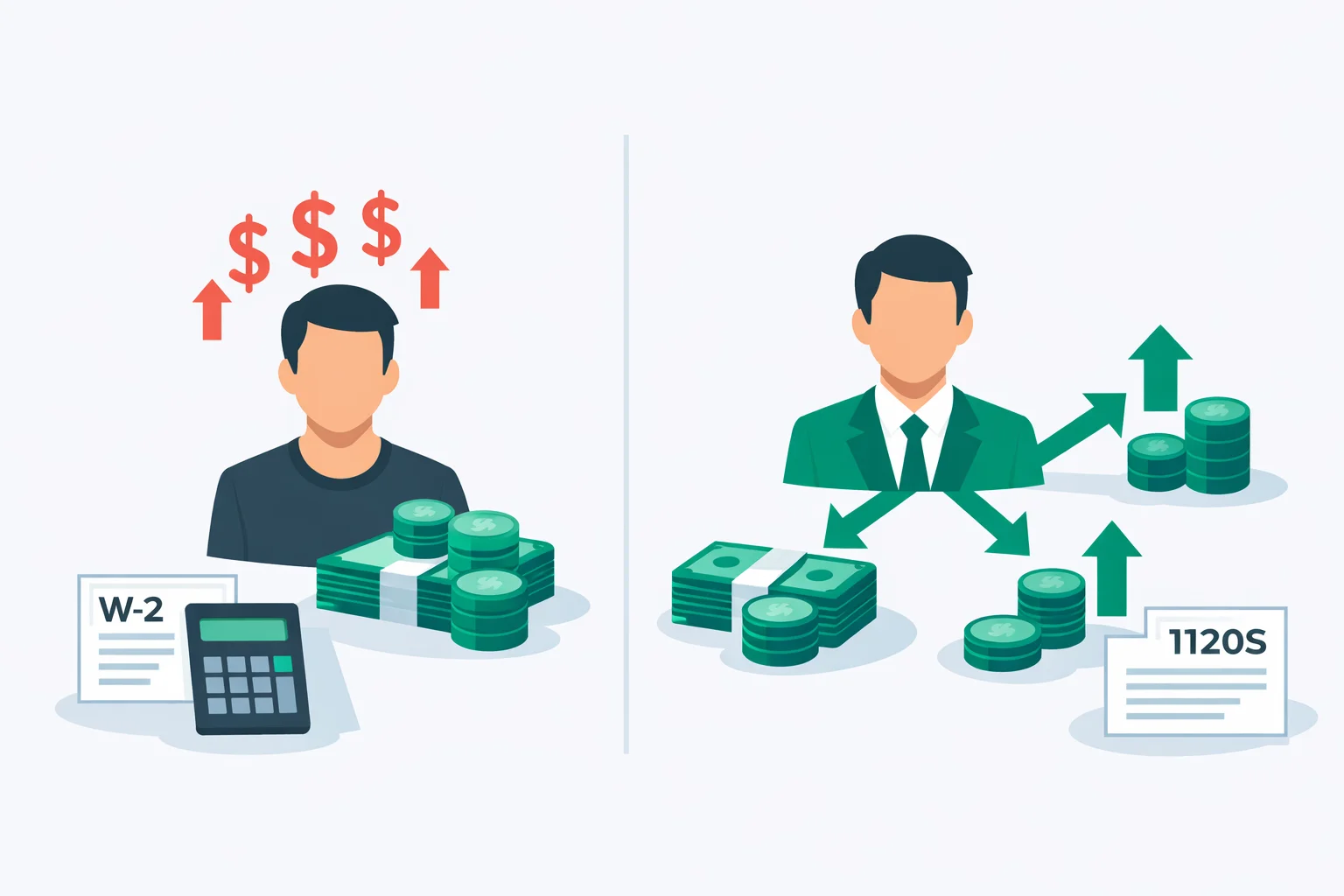
How S Corp Tax Savings Actually Work
The S Corp advantage comes down to one tax: self-employment tax. As a sole proprietor, the IRS treats your entire net business profit as self-employment income. You owe 15.3% in combined Social Security (12.4%) and Medicare (2.9%) taxes on 92.35% of that profit. There's no way around it — every dollar of Schedule C profit gets hit.
An S Corporation changes this by splitting your business income into two buckets: a W-2 salary (subject to payroll taxes) and a pass-through distribution (not subject to payroll taxes). The IRS requires that your salary be "reasonable" for the work you do, but any profit above that salary flows to you as a distribution that avoids the 15.3% SE tax entirely.
Here's the formula in plain terms:
- Sole Prop SE Tax = Net Profit × 92.35% × 15.3%
- S Corp Payroll Tax = Reasonable Salary × 15.3%
- SE Tax Saved = Sole Prop SE Tax − S Corp Payroll Tax
Worked Example: $150,000 Net Profit
Let's walk through a concrete comparison for a freelance consultant earning $150,000 in net business income, filing as single, with a 5% state tax rate and a $70,000 reasonable salary.
As a Sole Proprietor
Self-employment tax base: $150,000 × 92.35% = $138,525. Social Security tax: $138,525 × 12.4% = $17,177 (capped at the $176,100 wage base in 2025). Medicare tax: $138,525 × 2.9% = $4,017. Total SE tax: $21,194. You also deduct half of SE tax ($10,597) when calculating your adjusted gross income, which slightly reduces your income tax. After the standard deduction ($15,750) and the 20% QBI deduction ($30,000), your federal income tax comes to roughly $16,283. Add 5% state tax of $7,500, and your total tax bill is approximately $44,977. Your take-home: $105,023.
As an S Corporation
Your W-2 salary of $70,000 generates payroll taxes: $70,000 × 12.4% = $8,680 (Social Security) + $70,000 × 2.9% = $2,030 (Medicare) = $10,710 total. The employer half of payroll taxes ($5,355) is deducted by the corporation, leaving $74,645 as your pass-through distribution. That distribution is exempt from payroll tax. With the QBI deduction on the distribution ($14,929), your federal income tax drops to about $15,914. State tax stays at $7,232. Total tax: $33,856. Take-home: $116,144.
The S Corp saves $11,121 per yearin this scenario — primarily because you avoided paying 15.3% SE tax on $80,000 of pass-through income.
Key Factors That Affect Your S Corp Savings
Not every business owner saves the same amount. Five variables determine whether the S Corp election makes financial sense for your situation.
- Net business profit.The S Corp advantage grows with income. At $50,000 profit, savings might be $2,000-$3,000 — barely enough to cover admin costs. At $200,000+, savings routinely exceed $15,000 per year. Below $40,000, the S Corp rarely makes sense.
- Reasonable salary level. A lower salary means more distributions and more SE tax savings. But the IRS watches closely. Setting your salary at 40-60% of net profit is the sweet spot most CPAs recommend. Going below 30% dramatically increases audit risk.
- Social Security wage base.In 2025, Social Security tax applies only to the first $176,100 of wages. If your total income exceeds this cap, the savings from the S Corp structure are smaller on the Social Security portion since you'd cap out either way.
- State tax treatment. Some states (like California) impose a minimum $800 franchise tax on S Corps. Others (like Texas) have no state income tax, making the S Corp even more attractive. New York City adds an unincorporated business tax that the S Corp structure can help you avoid.
- Administrative costs. Running an S Corp costs $500-$2,000/year in payroll processing, separate tax return filing (Form 1120S), registered agent fees, and state annual report fees. Your savings need to exceed these costs to make the election worthwhile.
The Reasonable Salary Requirement
The IRS does not publish a specific salary amount. Instead, they use a facts-and-circumstances test. Courts have looked at factors including: training and experience, duties and responsibilities, time devoted to the business, comparable salaries at similar companies, and the compensation history of the S Corp owner. In practice, the IRS has challenged salaries as low as $24,000 for S Corp owners earning $200,000+ in profits.
A practical approach: research what your role pays on the open market using the Bureau of Labor Statistics Occupational Employment and Wage Statistics database. If a marketing consultant with your experience earns $65,000-$85,000 at an agency, your reasonable salary should fall within that range. Use the salary optimization table in our calculator above to find the exact number that balances tax savings with IRS compliance.
S Corp vs LLC: When Each Structure Wins
The S Corp isn't always better than an LLC. Use our LLC tax calculator to model your LLC tax burden side by side, or try the business entity comparison calculatorto see all four structures (Sole Prop, LLC, S Corp, C Corp) at once. Here's a decision framework based on the numbers we've seen across hundreds of calculations.
| Scenario | Best Structure | Why |
|---|---|---|
| Net profit under $40,000 | LLC / Sole Prop | Savings are $1,000-$2,000, eaten by S Corp admin costs |
| Net profit $40,000-$80,000 | Depends | Run the calculator — savings are $2,000-$5,000, borderline after costs |
| Net profit $80,000-$200,000 | S Corp | Clear savings of $5,000-$15,000/year, well above admin costs |
| Net profit $200,000+ | S Corp | Savings exceed $15,000/year — consult a CPA about C Corp comparison too |
| Planning to reinvest all profits | C Corp | 21% flat corporate rate is lower than top individual rates |
| Multiple owners, complex equity | LLC (Partnership) | S Corp limits: one class of stock, max 100 shareholders, no foreign owners |
Not sure if your profit is high enough to justify the S Corp election? Start with our sole proprietor tax calculator to benchmark your Schedule C tax bill against the three-way entity comparison (Sole Prop, LLC, S Corp) at your exact profit level.
Common Mistakes That Cost S Corp Owners Money
We've found that most S Corp tax mistakes fall into four categories, and every one of them has a specific dollar consequence.
- Setting salary too low.Paying yourself $30,000 when comparable positions pay $70,000 saves an extra $6,120 in payroll taxes — but an IRS reclassification adds back those taxes plus penalties (20-40% of the underpayment) and interest. The net cost of getting caught is $8,000-$12,000.
- Forgetting to run payroll.Some S Corp owners skip payroll and take all income as distributions. The IRS reclassifies 100% of distributions as wages, adds payroll taxes, and charges late- payment penalties. On $120,000 of distributions, that's $18,360 in payroll tax plus 5-25% in penalties.
- Missing the QBI deduction.The 20% Qualified Business Income deduction (Section 199A) applies to S Corp pass-through income, but many owners miss it or calculate it incorrectly. On $80,000 of distributions, that's a $16,000 deduction worth $3,520-$5,920 in tax savings depending on your bracket.
- Ignoring state-specific costs.California charges an $800 minimum franchise tax plus 1.5% on S Corp net income. If your profit is $60,000, that's $1,700 in state fees before any savings. In states like this, the S Corp breakeven point is higher. Use our state tax calculatorto check your state's treatment.
How to Elect S Corp Status
Filing for S Corp status takes one form: IRS Form 2553. You can file it within 75 days of forming your entity, or within 75 days of the start of the tax year you want the election to take effect. Late elections are possible with reasonable cause. Here's the step-by-step process:
- Form your entity— register an LLC or corporation with your state. An LLC electing S Corp status is the most common setup because it combines liability protection with pass-through taxation.
- Get an EIN — apply for a free Employer Identification Number from the IRS at IRS.gov.
- File Form 2553— all shareholders must consent. Mail or fax to the IRS. Approval typically arrives in 60 days.
- Set up payroll— use a payroll provider (Gusto, ADP, or QuickBooks Payroll) to process your W-2 salary. Budget $40-$100/month for this service.
- File Form 1120S annually— due March 15 (or September 15 with extension). This is the S Corp's separate tax return. Budget $500-$1,500 for a CPA to prepare it. You'll also need to make quarterly estimated tax payments on your pass-through income not covered by W-2 withholding.
Practical Tips for Maximizing S Corp Savings
Beyond the basic salary-distribution split, experienced S Corp owners use several strategies to push their tax savings further while staying IRS-compliant.
- Pay yourself a year-end bonus. Keep your base salary at the lower end of the reasonable range, then pay a bonus in December to hit the target. This gives you flexibility to adjust based on actual profits. For example, set a $60,000 base salary with a discretionary bonus of $10,000-$20,000 at year-end.
- Maximize retirement contributions.An S Corp can sponsor a Solo 401(k) with employer contributions. The employer can contribute up to 25% of W-2 wages. On a $70,000 salary, that's $17,500 in employer contributions plus $23,500 in employee deferrals — $41,000 sheltered from current taxes. Use our EBITDA calculator to see how reinvesting those savings grows your business value.
- Use an accountable plan for expenses. Reimburse yourself for legitimate business expenses (home office, mileage, phone) through an accountable plan. These reimbursements are tax-free to you and deductible by the S Corp, reducing both income and payroll tax exposure.
- Time your election.If you're converting from sole proprietor to S Corp mid-year, file Form 2553 by March 15 to get the full tax year benefit. A July conversion means you only get 6 months of savings. On $150,000 annual profit, that's $5,500 left on the table.
For a broader comparison of entity types including C Corps, check our corporate tax calculator. If you're self-employed and want to see your full 1099 tax picture, try our 1099 tax calculator or the self-employed tax calculator.
Understanding your effective tax rate is also critical when deciding between structures, since the S Corp doesn't change your income tax bracket — it only reduces the self-employment tax portion.